
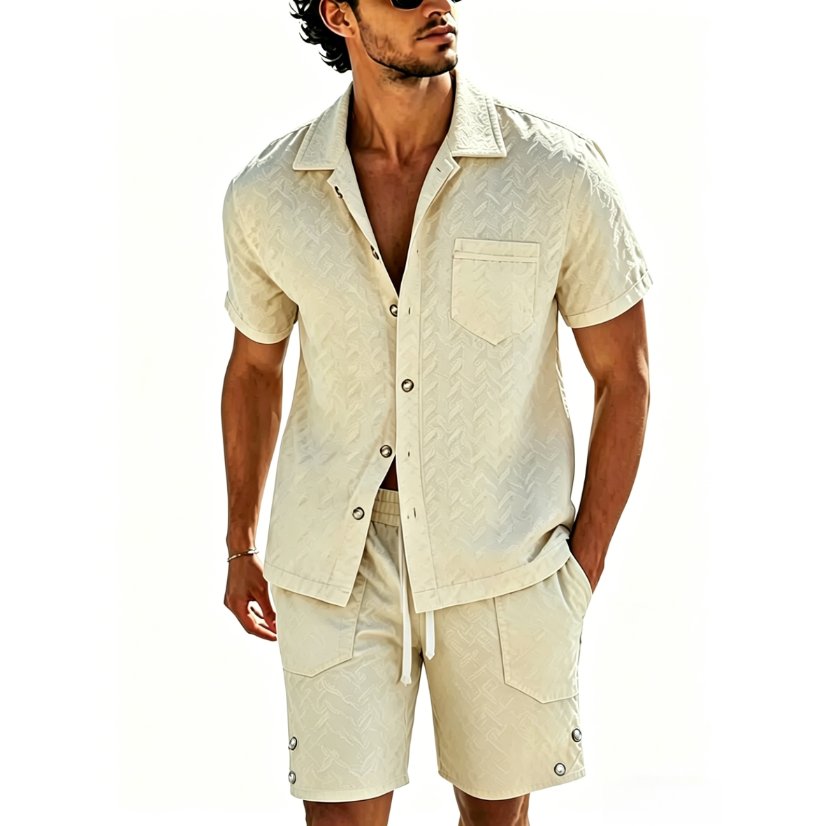
An XT03 jacquard appearance record should identify the selected catalogue version and review the top panels, collar, pocket and shorts as separate visible areas. Shuohuo’s XT03 page describes a jacquard cardigan set, and its gallery provides an ivory reference with a visible repeating texture. Use that image to locate appearance questions, then request identified views of the offered sample. A useful record distinguishes an accepted visible feature from an unobserved panel or an unanswered supplier question, without claiming that the photograph proves fabric construction or production consistency.
Identify XT03 and the selected gallery reference
Save the XT03 Shuohuo Jacquard Cardigan Set page with the selected image and reference date. Retain the exact product code in the sample request. The catalogue view shows a short-sleeve collared front-opening top and shorts, with a visible pocket on the top. These are useful location references for an appearance discussion, while the supplier should identify the actual offered version and any physical sample.
Give the image a buyer reference label and keep an untouched original. If a working copy is annotated, store it separately so the original remains available for comparison. The selected ivory view is an appearance reference rather than a controlled colour standard. Its lighting and garment arrangement should not be translated into an assumed colour tolerance, fabric depth or physical texture measurement.
• Use XT03 plus a dated image reference, not a generic jacquard-set label.
• Record the actual sample identifier when the supplier provides one.
• Keep each appearance comment connected to a named panel or detail.
Review each visible panel on its own terms
Label the front panels, collar, pocket and visible shorts areas before entering comments. A concern about the apparent direction of a repeat should point to a particular area and view. A general instruction to match the picture leaves several different questions unresolved: which panel, which edge, which orientation and which selected reference. Ask the supplier to respond to those specific locations.
Do not infer a pattern-matching rule from the catalogue arrangement. If a buyer requires a relationship between adjacent panels or a pocket and its surrounding area, state that as a requirement for supplier discussion. Keep the proposed requirement separate from what the photograph visibly shows. An appearance enquiry can define an intended relationship without claiming that current production has already achieved it.
Reference area
Appearance question
Evidence needed to close it
Top front panels
Visible repeat direction and selected overall appearance
Identified front view of the offered sample
Collar
Appearance relative to the selected top reference
View showing the collar clearly without concealing relevant edges
Pocket
Position and appearance of the visible pocket area
Labelled detail view for any specific query
Shorts panels
Visible repeat and relationship to the selected set reference
Identified view of the actual offered shorts
Reverse and covered areas
Details not shown by the current front reference
Additional views or an explicit not-observed entry
Ask for views that answer the actual panel question
Request the additional view needed for a particular unresolved area rather than a new collection of unrelated styling photographs. Link every reply to the same sample identifier. When possible, use a comparable orientation and presentation so shadows, folds and the camera angle do not obscure the detail under review. Keep the date and view label with the response.
The catalogue photograph does not show every rear panel, seam or concealed surface. Mark those areas not observed until the requested evidence arrives. Do not mirror the visible front onto an unseen back or treat an image of another colour option as proof of the selected sample’s hidden details. A clear evidence gap is more useful than a complete-looking map assembled from assumptions.
Keep visual acceptance separate from fabric specification
The page describes the main material as polyester and labels the fabric as jacquard. Keep that description attributed to the supplier’s selected product page. The appearance record does not independently establish fibre composition, how the fabric was produced or any measured durability. If those matters affect the purchase, request the relevant product-specific documents and review them separately.
Likewise, the page’s fabric-weight field needs its own defined basis before it becomes a buying specification. A photograph cannot resolve that unit question. An appearance decision about a visible repeat should not be copied into a technical record as acceptance of composition, mass, comfort or fit. Use the same product identifier across the documents while retaining the different scope of each decision.
Record decisions and revisions without losing their scope
For each area, enter a state such as accepted for appearance, supplier clarification requested or not observed. Name the reviewer and reference version. If the supplier proposes a different panel layout or another offered version, preserve the earlier view and record the change. A later reviewer should be able to see what was accepted and whether that decision applies to the current sample.
Send open panel questions through Shuohuo’s contact page with the labelled XT03 reference. The Shuohuo blog offers broader manufacturing discussion, but the actual sample file should retain the specific response and decision. The finished record is a usable map of visual observations for this set, with missing evidence visible and technical or commercial questions kept separate.
Frequently asked questions
Does the visible pattern prove the fabric construction?
No. Keep the supplier’s product description attributed to its source. The appearance record addresses visible features, while construction or composition evidence requires a separate supplier response.
Can a back panel be assumed to match the front?
No. Mark it not observed and request the relevant identified sample view when that information is needed.
Should pocket-to-panel pattern matching be assumed?
No. State any required relationship explicitly for supplier discussion and record the actual response. Do not invent a matching tolerance from a styled photograph.
What should remain with the approval file?
Keep the exact XT03 reference, untouched image, annotated working view, actual sample identifiers, supplier replies and dated appearance decisions. Preserve earlier versions when a proposal changes.
Product and contact references
https://shcasualwear.com/product/xt03-shuohuo-jacquard-cardigan-set/
https://shcasualwear.com/contact/
https://shcasualwear.com/blog/