
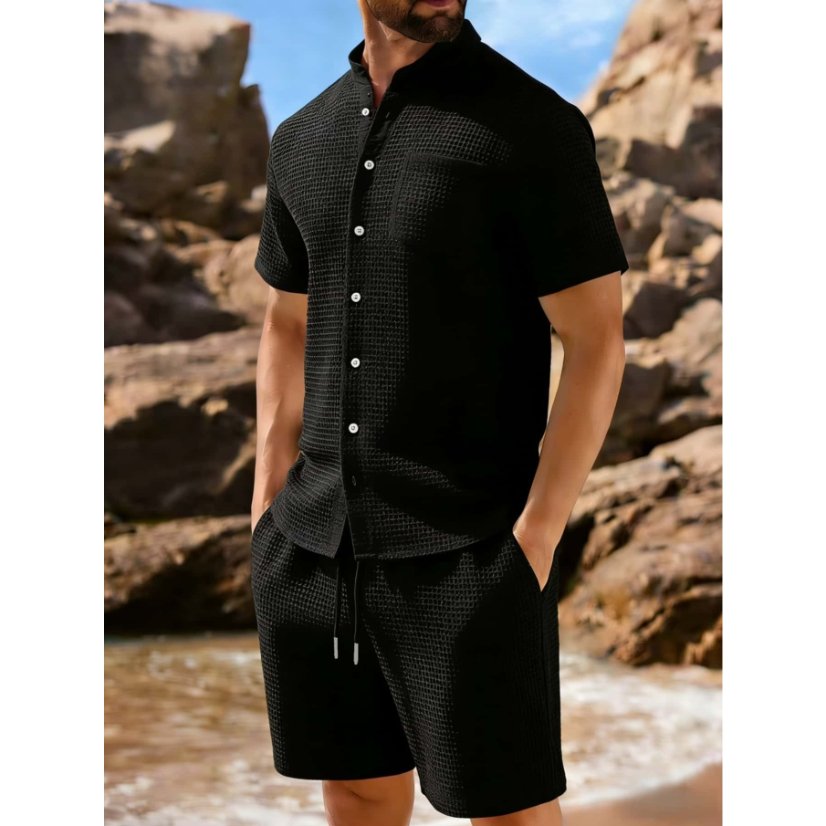
Keep XT01 and XT001 as different exact text codes in an apparel RFQ. Shuohuo’s current catalogue names XT01 as a Linen-Blend Sleeveless Set and XT001 as a Waffle-Knit Cardigan Set. Removing or adding a zero can therefore point an enquiry toward a different named reference. Build a model-code crosswalk that retains the exact code, product name, official link and selected image together, then ask the supplier to confirm the offered version. A catalogue card identifies a reference; it does not replace product-specific specification or quotation confirmation.
Save the complete catalogue identity rather than a shortened code
Start with the XT001 Waffle-Knit Cardigan Set reference linked from Shuohuo’s homepage. Retain the full code and displayed product name. The black short-sleeve set image helps a buyer identify the intended reference, while material percentages, dimensions and supply details still need their own applicable supplier response. Do not import specifications from another model because its code looks similar.
Give the enquiry line an internal identifier without replacing the supplier’s catalogue code. Record both fields so a buying team can use its own numbering system while preserving the original reference. The official link and selected image should stay beside the code, not in an unrelated folder that the supplier has to search. This makes an accidental code change easier to spot before a quotation is accepted.
• Catalogue code: preserve every letter and digit as displayed.
• Product identity: keep the actual product name, link and selected image together.
• Supplier reply: identify the exact offered version and any alternative explicitly.
Use the actual catalogue names to expose near matches
The homepage presents several codes that can be mistyped or shortened. Record them as separate rows when they are relevant to the enquiry. Similar spelling does not establish interchangeable products, equivalent fabrics or a shared specification. A crosswalk should help the supplier identify what the buyer meant, rather than normalising distinct names into one broad set category.
Two entries may share a broad catalogue description while remaining separate model references. Keep them distinct until the supplier explains any relationship. If an alternative is proposed, give it its own row and retain the original request. A substitution becomes traceable when the buyer can compare the requested and offered codes instead of finding that the original code was overwritten.
Exact homepage code
Displayed catalogue name
Handling in an enquiry
XT01
Linen-Blend Sleeveless Set
Keep distinct from the longer XT001 code
XT001
Waffle-Knit Cardigan Set
Retain both zero characters in the numeric portion
XT03
Shuohuo Jacquard Cardigan Set
Do not shorten to a generic cardigan reference
XT006
Polo-Style Jacquard Set
Preserve the complete three-digit numeric portion
XT013
Polo-Style Jacquard Set
Keep a separate row despite the similar product-name category
Prevent spreadsheet and message shortcuts from changing identity
Store catalogue codes as text and compare the complete character string when preparing a buying sheet. A convenient internal shorthand can be useful, but it should have a visible link back to the exact external code. Do not use a partial numeric match to select a product line. Review the code, name and reference image together before sending the enquiry.
The same discipline helps when copying a request into an email, a quotation sheet or an internal order system. Keep the reference row intact through each transfer. If an attachment or supplier response omits the code, ask which recorded row it concerns instead of assigning it by appearance alone. A visually similar item can still have an unconfirmed material, construction or offered-version difference.
Match supplier answers at the level their evidence supports
Ask the supplier to repeat the requested model code or identify its own offered identifier in the reply. If the reply confirms only a catalogue reference, keep that scope visible. A product card and picture can identify the enquiry target, but they do not establish the current offer’s composition, available assortment, packing contents or price. Those fields need the applicable response for the actual item being offered.
Where the buyer receives an actual sample, record its identifier and any attached model label beside the catalogue row. Keep an unmatched sample unresolved until the supplier clarifies its identity. Do not relabel it to the requested model simply because the garment looks similar. This protects the later appearance, measurement and material reviews from being attached to the wrong reference.
Close the crosswalk with a recorded version and open questions
Use clear states such as requested, supplier reference confirmed, alternative offered or identity clarification pending. Keep the date and exact supplier wording with each change. When a model identifier is corrected, preserve the earlier entry and explain which current row supersedes it. An alternative can be reviewed without erasing the buyer’s original request or inventing a technical equivalence.
Send unresolved identity questions through Shuohuo’s contact page with the crosswalk attached. The Shuohuo blog contains broader apparel-manufacturing discussion, while this document keeps a specific model enquiry traceable. The useful result is a confirmed reference or a clearly open question, with exact characters preserved and later product-specific decisions linked to the correct item.
Frequently asked questions
Are XT01 and XT001 just two ways to write one model?
The current catalogue presents them with different product names and links. Keep them separate and ask the supplier to confirm the exact offered reference rather than removing a zero.
Do matching broad product names make XT006 and XT013 interchangeable?
No equivalence is established by the shared catalogue category. Retain the exact codes and request the supplier’s applicable product-specific information.
Does the XT001 homepage image establish its fabric specification?
No. It provides an identification reference. Obtain the material, dimensional and commercial details that apply to the actual offered version instead of copying them from another model.
What if an unlabelled sample appears to match the requested picture?
Record the sample separately and ask the supplier to clarify its identity. Do not attach a catalogue model code by visual similarity alone.
Product and contact references
https://shcasualwear.com/product/xt001-waffle-knit-cardigan-set/
https://shcasualwear.com/contact/
https://shcasualwear.com/blog/